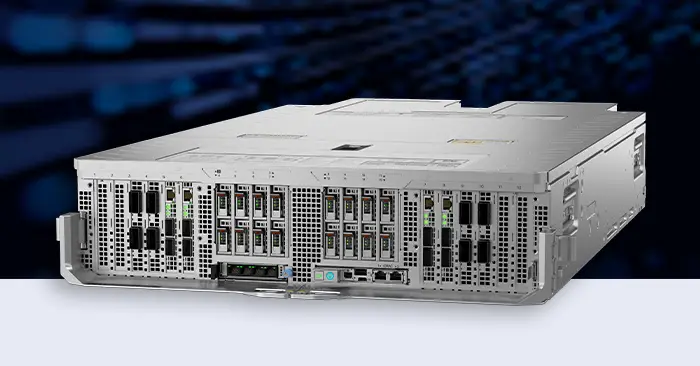
Deploy scalable agentic AI with Dell PowerEdge XE9780LAP servers and Intel Xeon 6 processors
AI technologies are revolutionizing the modern workplace at an unprecedented pace. AI chatbots have reinvented information curation and retrieval, and GenAI has unlocked prompt-based content creation for the masses. Now, agentic AI tools are enabling major productivity gains across industries, from factory floors to trading desks to software teams. For businesses that embrace agentic AI, agents can act as both project managers and highly skilled workers, translating broad directives into multi-step workflows, checking progress and quality, and integrating feedback into process improvement, with minimal human intervention. It’s no overstatement to say that agentic AI has the potential transform your business from top to bottom.
Depending on the workflow, an agent completing a single task can trigger hundreds or even thousands of interactions among AI models, orchestration frameworks, tools, and data sources. Server GPUs often carry the inference load, while CPUs handle orchestration, retrieval, and all the on-system work the agents actually perform. As organizations trust agents with more of their data and work, compute demands grow, and token burn can become a serious budget problem. For IT decision-makers, the challenge is choosing AI infrastructure that can support today’s agentic workloads, scale efficiently, and be ready to adapt as the technology evolves.
The Dell PowerEdge XE9780LAP is a high-density, liquid-cooled AI server that supports up to two Intel Xeon 6 processors, up to 6 TB of DDR5 memory, and up to eight NVIDIA B300 GPUs connected through NVIDIA NVLink. With Intel Advanced Matrix Extensions (Intel AMX), the PowerEdge XE9780LAP can accelerate moderately complex AI work on the CPUs alone, while GPU acceleration can greatly expand agent capacity. But specifications alone won’t tell IT buyers how many agents an XE9780LAP server configuration can support, how responsive those agents will be, or what the tokenomics might look like. We tested the server to find out.
How we tested agentic AI performance
Many existing agentic benchmarks focus only on accuracy, or how well the agent did its job. For this study, we wanted to focus on performance, with the goal of providing sizing guidance for organizations choosing a server configuration for their agentic workloads.
To do this, we used PT’s custom agentic benchmark to run real-world, end-to-end agent workflows on a PowerEdge XE9780LAP with two Intel Xeon 6979P processors and eight NVIDIA B300 GPUs. Our tests included three types of workloads:
-
A manufacturing workload with eight workflows, such as predictive maintenance and vision-based quality inspection
-
A financial services workload with eight workflows, such as fraud investigation and transaction reconciliation
-
An autonomous coding workload with 16 scenarios, each running a bug-fix loop
We measured performance across both CPU-only and CPU+GPU configurations. We ran the GPU tests with all eight GPUs, then ran a moderate financial workload on the CPUs alone, with Intel AMX enabled and disabled. For the GPU tests, we measured how many agents the server supported within service level agreement (SLA) latency thresholds, throughput in tokens per second, and cost per million tokens ($/Mtok). For the CPU-only tests, we measured the number of supported agents.
What the testing found
In our tests, the Dell PowerEdge XE9780LAP server with Intel Xeon 6979P processors delivered strong agentic AI performance both with and without NVIDIA B300 GPU acceleration:
-
On the manufacturing workload, the server supported 205 AI agents and delivered 3,139 tokens per second at $0.43/Mtok.
-
On a late-stage financial services workload with a 30-second SLA, it supported 62 agents at $1.26/Mtok.
-
On the coding workload, it supported 14 agents at the lowest cost we measured, $0.25/Mtok.
-
Running on CPUs alone with Intel AMX, the server supported 57 agents on a moderate financial workload at BF16 precision. At FP32 precision, it supported 21 agents with Intel AMX enabled and none with it disabled.
What this means for AI infrastructure teams
The Dell PowerEdge XE9780LAP gives organizations room to grow at every stage of their agentic AI journey. You can start running early-stage agents on Intel AMX-accelerated CPUs, then add GPUs as agents take on more data, larger models, and more concurrent work. Paired with real-world sizing data, that flexibility can help you avoid under- or over-provisioning for AI while investing in configurations that best fit your company’s workloads.
To learn more about the agentic AI performance and tokenomics of the Dell PowerEdge XE9780LAP, check out the report and infographic below.


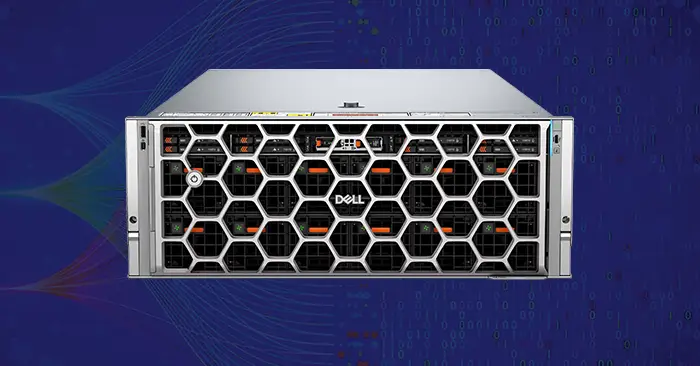

Principled Technologies is more than a name: Those two words power all we do. Our principles are our north star, determining the way we work with you, treat our staff, and run our business. And in every area, technologies drive our business, inspire us to innovate, and remind us that new approaches are always possible.


